
Singulator, gentleMACS, or manual prep: an honest comparison
Three ways to turn tissue into sequencing-ready cells or nuclei in a shared core. Each one earns its place in some labs. Here is where each fits, where each does not, and what the published data shows, so you can decide on the work your core actually runs.
Contact a SpecialistTalk through the tissue types your core finds hardest to standardize, and how the Singulator handles them.The gentleMACS Octo is a capable, widely trusted instrument. So is a skilled pair of hands.
This page does not pretend otherwise. The question for a core director is narrower than "which is best in the abstract." It is: across many operators and a different sample on every shift, which approach holds quality steadiest, and which one fits the range of tissue you take in? That is the lens below.
Key takeaways
- The Singulator, gentleMACS Octo, and manual prep all turn tissue into sequencing-ready cells or nuclei; they differ in how much of the workflow stays in an operator's hands.
- The Singulator's edge is operator-independent, software-controlled standardization, plus a fully automated, xylene-free FFPE-to-nuclei path on one instrument.
- gentleMACS still fits a lab already standardized on the MACS reagent ecosystem with downstream magnetic enrichment.
The three approaches, in one look
Most shared cores reach for one of three options. They differ less in whether they can produce a suspension, and more in how much of the work stays in an operator's hands, which is where prep quality drifts.
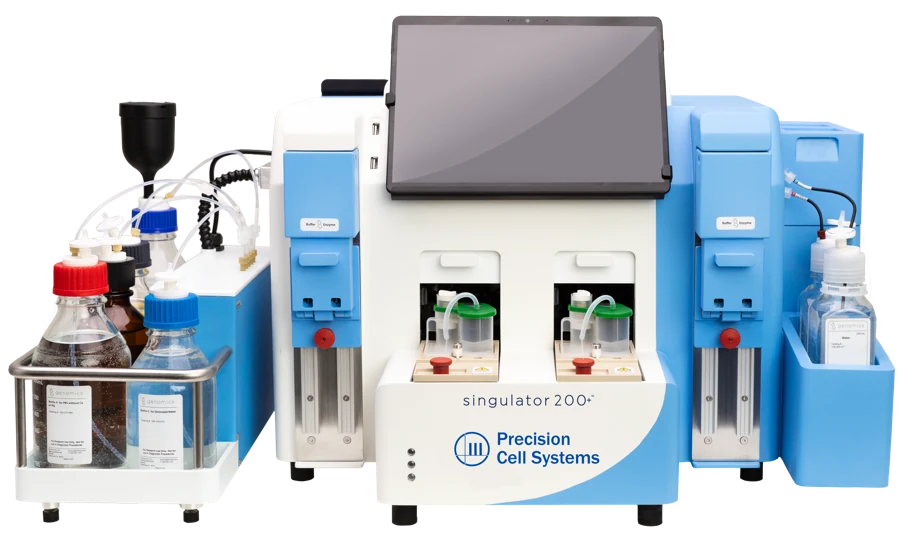
Singulator 100 / 200 / 200+
Automated single-cell sample prep system (PCS)
Software-controlled protocols run inside an enclosed single-use cartridge. The operator loads tissue, presses start, and walks away. Same timing, force, temperature, and chemistry on every run.
Strongest where a core needs one standard across many operators and the full intake range, including automated FFPE-to-nuclei.
Honest limit a consumable cost per run, and a published cell-side viability number is still pending.
gentleMACS Octo with Heaters
Semi-automated tissue dissociator (Miltenyi Biotec)
A proven benchtop dissociator. Tissue and reagents go into gentleMACS tubes, you select one of 80+ programs, and the instrument runs the mechanical step. Heating, cooling, and up to eight tubes at once.
Strongest where a lab already runs the MACS reagent ecosystem and wants automated, repeatable dissociation with downstream magnetic enrichment.
Honest limit buffer prep, transfers, filtration, and FFPE deparaffinization stay manual, so operator variability is reduced, not removed.
Manual prep
Dounce plus density-gradient or column cleanup
The universal baseline. Pennies per sample, endlessly adaptable, and excellent in expert hands. Every step, from mincing to cleanup to the count, is performed by a person.
Strongest where a single skilled operator runs a narrow, familiar set of tissues and capital is unavailable.
Honest limit operator-dependent by nature. Technique drifts as the method passes between people, and there is no FFPE-to-nuclei path.
Across eight axes, the gap is standardization, not capability
Eight axes a core director weighs when standardizing the front end. The marks reflect what each approach does today, drawn from published studies, the manufacturers' own specifications, and PCS application data. Where an approach does something well, the page says so.
| What you are weighing | Singulatorautomated sample prep system | gentleMACS Octosemi-automated dissociator | Manual prepdounce plus cleanup |
|---|---|---|---|
| Standardization across operators | Operator-independent Software-controlled protocols set timing, force, temperature, and chemistry. The senior scientist and the new hire trigger the identical sequence. | Partly automated 80+ predefined programs standardize the mechanical step. The buffer prep, transfers, and filtration around it stay manual, so technique still varies. | Operator-dependent Quality tracks who is at the bench. The SOP describes good hands; it cannot reproduce them. |
| Hands-on workflow | Load and walk away Enclosed single-use cartridge with inline filtration and zero internal fluidics. 15 manual steps reduced to 2 hands-on steps versus a manual dounce. | Reduced, not removed The instrument runs the dissociation. The operator still prepares buffers, loads enzyme, transfers tubes, and filters the output by hand. | Fully manual Every step is hands-on, roughly 45 to 90 minutes of active work per sample. |
| Cells or nuclei output | Both, one platform Sequencing-ready single cells or single nuclei from the same instrument family, by cartridge choice. | Both Produces viable single cells or intact nuclei with the appropriate kits and buffers. A genuine strength of the platform. | Both, with effort Achievable for both, but each needs its own optimized manual protocol and skilled execution. |
| FFPE archival tissue | Automated, xylene-free The 200+ runs automated deparaffinization to nuclei from a 50 µm curl in about 60 minutes, no xylene handling, under 5 minutes hands-on. | Supported, manual front end FFPE is listed among compatible tissues, but deparaffinization is still a manual xylene step in a fume hood before the instrument runs. | No standard path No routine FFPE-to-nuclei workflow. Archival blocks are typically declined or outsourced. |
| Gentleness on fragile populations | Cold, enzyme-free nuclei Integrated 4 °C control and enzyme-free nuclei chemistry. In frozen mouse cortex, ~100% structurally intact nuclei versus ~85% and ~35% for the compared methods (Kersey 2026). | Gentle, with caveats Optional coolers and gentle programs help, and the platform preserves surface epitopes well. Enzymatic digestion at 37 °C and rotor-stator shearing can still stress some populations. | Variable Gentle in expert hands; harsh when technique slips. Enzymatic dissociation at 37 °C can induce artifactual stress signatures in brain (Marsh 2022). |
| Low-input & archival specimens | 2 mg, standardized Validated for inputs as low as 2 mg and a 50 µm FFPE curl, with the same automated, standardized prep on biopsy-scale and archival material. | Capable, operator-dependent Also runs low and routine inputs; the FFPE front end is manual and precious-sample handling stays operator-dependent. | Hard at low input Small inputs are where manual loss is highest. Precious material is the riskiest thing to run by hand. |
| Run-to-run provenance | Native digital run log Every run writes an exportable record, the structured provenance S10 reviewers, IRB packets, and NIH data-management plans increasingly expect. | Program-level records The touchscreen logs the program used. The surrounding manual steps live in the operator's notebook, not an instrument record. | Manual notebook Provenance is whatever the operator wrote down, which rarely meets structured-documentation expectations. |
| Replicate consistency | Identical replicate yield On a single mouse PDAC block, identical replicate yield of 1.0M and 1.0M, where a manual workflow on the same material swung close to four-fold (1.5M and 0.4M). n = 4. | Improves on manual Automating the mechanical step tightens reproducibility relative to fully manual prep. Head-to-head replicate figures against the Singulator are not published. | Widest spread Replicate yields from the same block can differ enough to change a downstream decision. |
If a lab is already standardized on the MACS reagent ecosystem and routinely follows dissociation with magnetic cell enrichment, the gentleMACS line fits that workflow well, processes up to eight tubes at once, and has a deep installed base and a long track record. None of that is in dispute. The Singulator's argument is narrower and specific to the shared-core job: removing the manual steps that sit around the automated one, so prep quality stops depending on who ran it, and covering FFPE on the same instrument without a separate xylene workflow.
Two differences decide it: what 'automated' covers, and what the nuclei data shows
"Automated dissociation" and "operator-independent prep" are not the same claim
This is the distinction that matters most for a shared core, and it is easy to miss. A semi-automated dissociator automates the single hardest-to-standardize step, the mechanical disruption, and that is a real gain over a hand dounce. What it does not automate is everything around that step: making up buffers, adding enzyme, moving tubes, filtering the output, and any downstream cleanup. Those steps still run on human hands and human timing, so they still drift between operators and shifts.
The Singulator runs that whole sequence inside one enclosed cartridge under software control. The practical difference shows up on the day the senior tech is away and a newer hire runs a sample a PI has already been charged for, since any method can look clean on a good day. The fewer manual steps sit between the tissue and the suspension, the less room there is for that day to look different from the last one.
What the published nuclei data actually shows
For nuclei, there is third-party, peer-reviewed evidence rather than a vendor claim. In a comparison of nuclei isolation methods on frozen mouse cortex, the Singulator produced about 100% structurally intact nuclei, against about 85% for a sucrose-gradient prep and about 35% for a column kit, with under 0.5% mitochondrial reads and the lowest sample-to-sample variability of any method compared.
Kersey et al., 2026, Cell Reports Methods. Singulator 100, frozen mouse cortex.On the cell side, the most useful third-party benchmark is still being assembled, so this page does not put a cell-recovery or viability number on it. The honest read: nuclei are where the strongest independent evidence sits today, and that is the workload where the gap between an instrument-controlled prep and a hand-run one is most clearly documented.
So which should your core run?
The right answer depends on the work in front of you. A reasonable way to choose:
The Singulator fits when
- You answer for reproducibility across many PIs and a rotating bench, on a chargeback model.
- Your intake spans fresh, frozen, OCT, and FFPE, for cells and nuclei, and you want one workflow for all of it.
- You take in archival blocks or biopsy-scale tissue and want them processed in-house instead of declined.
- You need exportable run provenance for S10, IRB, or NIH data-management plans.
gentleMACS or manual may fit better when
- One skilled operator runs a narrow, familiar set of tissues, and that is unlikely to change.
- You are already standardized on the MACS reagent and enrichment ecosystem and want to stay inside it.
- Capital is unavailable this cycle, and manual remains the only option that fits the budget.
- Your samples are routine, plentiful, and never FFPE.
The sharpest read comes from your own tissue, the sample type you already find difficult, weighed against the data your downstream actually depends on. A spec sheet cannot show you that.
Your intake queue changes every day. Your prep quality shouldn't.
Talk to a PCS specialist about the tissue your core finds hardest to standardize, the assays it feeds, and how the Singulator holds quality steady across operators. Bring the workflow you are trying to fit, and you will get a straight answer on whether it suits your core.
Contact a Specialist →A PCS application scientist reviews scientific and workflow fit on every conversation.