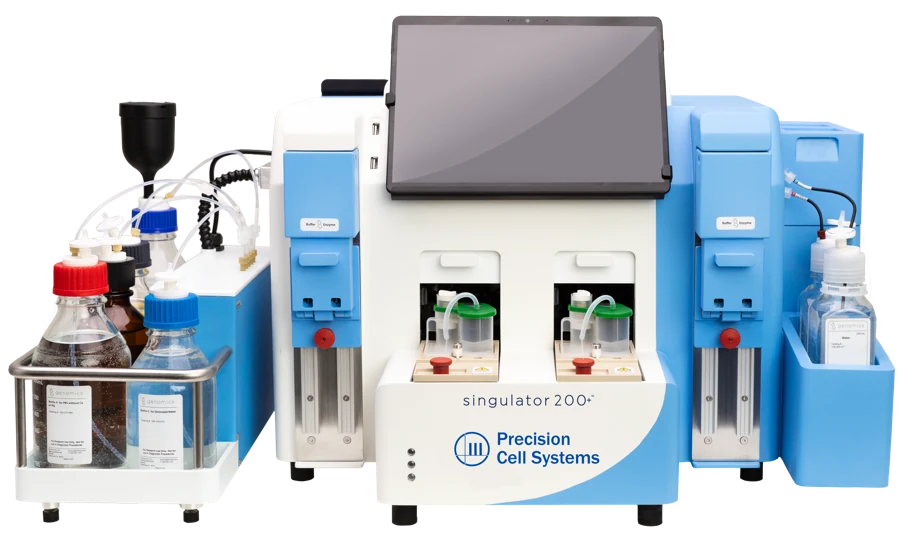
Standardize your core's single-cell prep across every sample you run
Your intake queue changes every day. Your prep quality shouldn't. The Singulator turns fresh, frozen, and FFPE tissue into sequencing-ready cells or nuclei to one standard of quality, whoever is on the bench. Talk through the fit with a PCS specialist before you commit.
No charge, no obligation. A PCS specialist talks through scientific and workflow fit with you.
The front end is the step a shared core controls least
A core takes in different tissues from different PIs every shift. The sequencer is consistent. The prep is the one step that drifts with whoever is at the bench. That drift surfaces downstream in ambient RNA, in rare populations lost before they reach the sequencer, and ultimately in a failed run charged back to a PI.
Where prep variability comes from
Manual prep is operator-dependent by nature. Buffer prep, transfers, filtration, and timing pass between people, and the SOP drifts with them. Onboarding a new hire means re-teaching technique that lives in one person's hands.
What standardizing it gives you
Move that variability off the bench and into a software-controlled instrument, and the senior scientist and the rotating new hire produce comparable prep quality. The core can stand behind its data across people, shifts, and sample types.
The result depends on the sample, not the bench.
Built for a multi-user core
One instrument that fits the whole core's intake
One standard your whole core can run
Software-controlled protocols hold the same timing, force, temperature, and chemistry every run. The method lives in the instrument, so it survives staff turnover and writes a digital record of itself.
Kersey 2026: the lowest sample-to-sample variability of any compared method.
One platform for every sample type
Fresh, frozen, OCT, and FFPE, for cells or nuclei, on one footprint and one workflow family. FFPE is one of the sample types the single instrument handles, on equal footing with fresh and frozen.
The Yale Center for Genome Analysis (YCGA) runs scRNA-seq, snRNA-seq, ATAC-seq, CITE-seq, and FACS off one Singulator footprint.
The smallest sample in your core
Needle biopsies, rare tissue, and limited patient specimens are the ones you cannot waste on a failed prep. Validated inputs as low as 2 mg, with quality preserved by cold, enzyme-free chemistry.
Validated to 2 mg and a 50 µm FFPE curl. Cold, gentle processing protects scarce material.
The evidence behind the standard
Every figure here is from third-party or application-note data. Pulled with its source so your team can check it.
~100%
structurally intact nuclei from frozen mouse cortex, vs ~85% (sucrose gradient) and ~35% (column kit).
Kersey et al. 2026, Cell Reports Methods, DOI 10.1016/j.crmeth.2026.101337
<0.5%
mitochondrial reads, with among the lowest ribosomal content of any compared method. Cleaner inputs, less to clean downstream.
Kersey et al. 2026, Cell Reports Methods
81%
less hands-on time vs a manual workflow: 15 manual steps reduced to 2 hands-on steps.
PCS workflow comparison vs manual dounce
A multi-omics core can run every assay off a single Singulator footprint.
What it is
An automated single-cell sample prep system
It turns tissue into sequencing-ready cells or nuclei on a software-controlled instrument, so prep quality tracks the sample itself, consistent across whoever is at the bench.
Software-controlled protocols. Identical timing, force, temperature, and chemistry every run, set in software.
Enclosed single-use cartridges with inline filtration and zero internal fluidics, so there is no cross-contamination and nothing to maintain between runs.
Cold, enzyme-free chemistry with integrated 4 °C control protects fragile populations on the nuclei side.
Native digital run logs on every run. Exportable provenance for SOPs, IRB, S10 instrumentation grants, and NIH data-management plans.
Output feeds directly into the platforms your PIs already run, so standardizing the front end does not lock you into any one downstream chemistry:
10x Chromium10x FlexBD RhapsodyParse Evercode
Throughput is on par with established semi-automated methods, without the manual technique they require. One operator runs the instrument walk-away, so you scale capacity by adding instruments rather than headcount.
How to get started
A short, low-friction conversation with a PCS specialist to evaluate whether the Singulator fits your core, before any purchase decision.
1
Tell us your intake
Share your core's sample types, the downstream platforms you feed, and the samples you struggle to standardize. A PCS application scientist starts from your real workflow.
2
Map it to your assays
A specialist maps the Singulator workflow to the assays your core runs and reviews the published data with you, against the inputs and QC criteria that matter to your samples.
3
Get a clear read on fit
You leave with a straight read on whether the Singulator fits your core, the data behind it, and clear next steps. No obligation either way.
They do get excellent results, and the Singulator keeps that expertise by encoding the expert's standard into a protocol that runs the same way whoever is at the bench.
The exposure shows up when that person is at a conference, on vacation, or has left. A newer hire then runs a sample the PI has already committed to. Standardizing the prep is resilience for the core, not deskilling of the scientist.
Will we get locked into your protocols and cartridges?
Software-controlled means consistent and updatable. The validated protocols are yours to run and adjust, and the consumable model is the category standard that labs already work inside.
The number that matters is all-in cost per usable sample, which the cartridge price alone misses. With the lowest published sample-to-sample variability, one avoided downstream failure pays for many cartridges.
FFPE blocks and hard tissues vary enormously. Can one instrument really handle the difficult ones?
Block-to-block variability is real, and no instrument erases it. What the Singulator removes is the operator-added variability layered on top: handling, timing, and technique.
For severely degraded archival material, the right move is a quick block-quality check before committing a precious curl. A PCS specialist can walk through how your hardest tissue is likely to behave and help set those criteria with you.
Does standardized prep help the case for an instrumentation grant?
Standardizing the most variable step and documenting it strengthens the provenance story. Every run writes a native digital record, which aligns with the NIH Data Management and Sharing Policy and with reproducibility expectations for shared resources.
For a shared core accountable to many PIs, that turns a soft reproducibility argument into a documented one.
Talk through the fit for your core
Contact a PCS specialist and an application scientist will map the Singulator to your core's real intake. You get a clear read on standardized single-cell prep, with your downstream platform in mind, before any purchase decision.