Your intake is widening.
Archival FFPE, frozen biobank samples, and new tissue types keep landing in your queue. FFPE alone means three 10-minute xylene washes by hand, and no automated path from block to nuclei.

The Singulator automates the whole workflow, not just the grind: reagents, filtration, temperature, and nuclei isolation.
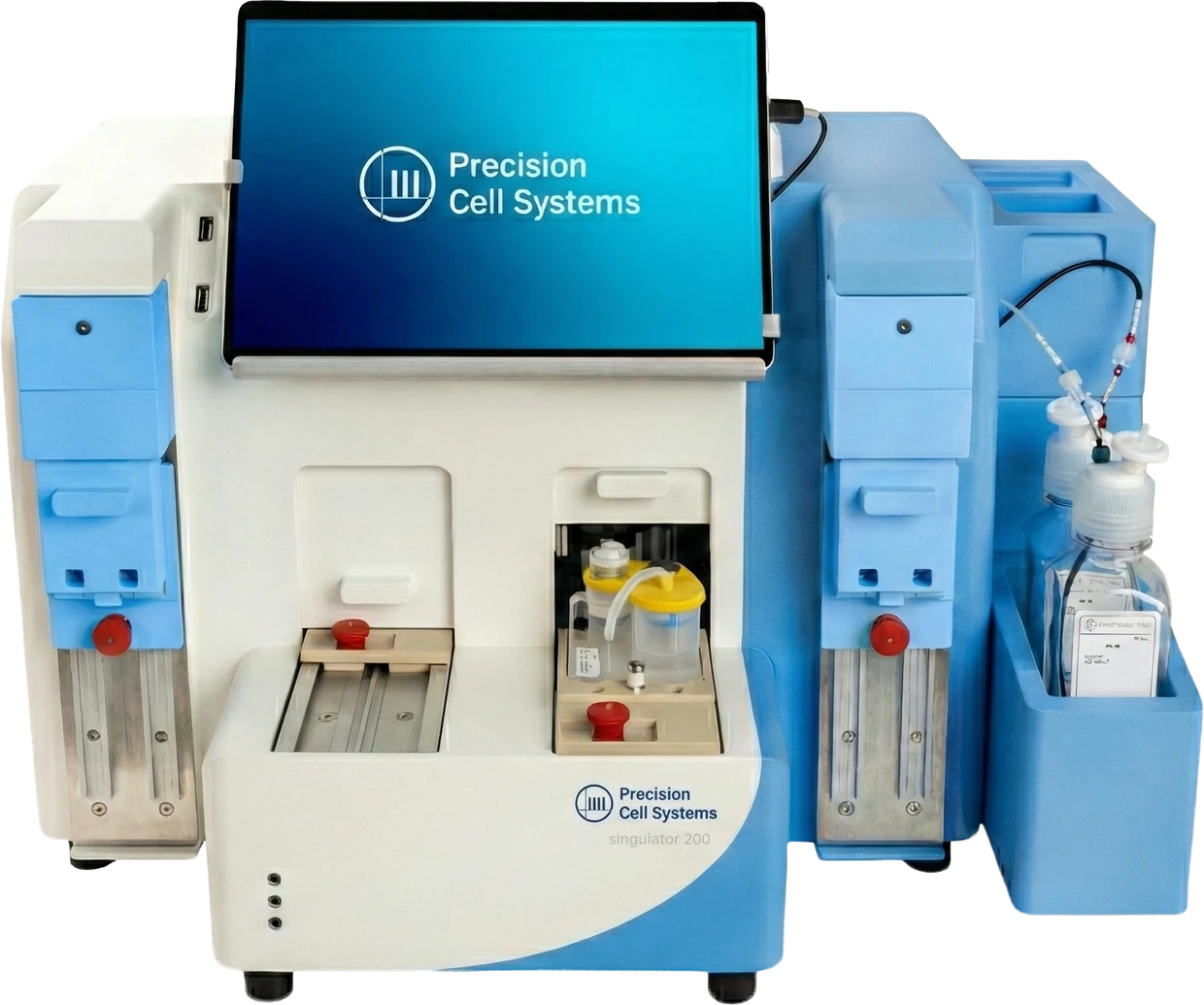
Archival FFPE, frozen biobank samples, and new tissue types keep landing in your queue. FFPE alone means three 10-minute xylene washes by hand, and no automated path from block to nuclei.
Results depend on who performs the prep. When a labmate's prep comes out different, the variance traces to the manual steps around the instrument, not the grind it automates.
A skilled operator moved on, and the technique went with them. No protocol had captured the judgment calls they made. The next hire starts over on the steps the instrument never ran.
Reproducibility runs through all three, and the manual steps around the gentleMACS keep putting it at risk.
This is not a contest over which instrument grinds tissue better. The gentleMACS earned its installed base on exactly that step, but the grind is only part of a prep.
What survives the disruption matters too: the Singulator disrupts at low shear under software control, so a precious 2 mg sample comes off the instrument with its nuclei intact.
This is the decision in front of any lab choosing how to prep, whether you are weighing a gentleMACS or a move away from one, and it comes down to three questions: how much of the result still depends on who is at the bench, how many of your sample types you can run to one standard, and what happens to your method when the operator who tuned it leaves. Judge the two platforms on those three, and the comparison stops being about the grind.
Operator-independence
One standard across your sample range
A method that survives the operator
Every gentleMACS entry below is read from Miltenyi's own published protocols and catalog. Where the two platforms do the same thing, the table says so.
| What you are weighing | gentleMACS Octo with Heaters as published by Miltenyi | Singulator 100 / 200 / 200+ |
|---|---|---|
| How much of the run the instrument controls | One program. In their published nuclei protocol, the instrument runs 4C_nuclei_1. Buffer prep, tissue cutting, transfers, filtration, the spin, and the resuspension all fall outside it. |
Reagent delivery, timing, disruption speed, temperature, chemistry, filtration, and nuclei isolation. All set in software and executed the same way on every run, with the sample sealed inside single-use cartridges. |
| What still runs by hand | Buffer prep, tissue cutting on dry ice, transfers, two rounds of strainer filtration, a centrifugation, and a resuspension their protocol specifies as “slowly and gently pipetting the sample up and down for 10 times.” | Gross mincing, on tissues where PCS recommends doing it by hand. Loading the cartridge, and on the FFPE run, transferring the tissue between cartridges. Four pipetting steps on that FFPE workflow. And short benchtop spins, with a resuspension, once the nuclei come off the instrument. |
| Your reagents and protocol | A tissue-specific dissociation kit per tissue type, per the Miltenyi catalog. Their chemistry, their kit, their tissue list. | Open reagent platform. Run PCS's validated reagents, or load the protocol your lab already optimized. Including 10x protocols. |
| Your sample range, including FFPE | Fresh and frozen tissue, cells or nuclei with the appropriate kits. FFPE is listed among compatible tissues, but deparaffinization is three 10-minute xylene washes plus an ethanol gradient, by hand, in a fume hood, before the instrument runs. | Fresh, frozen, OCT, and FFPE. One platform delivers a whole-cell suspension or clean isolated nuclei, by cartridge and protocol. On the 200+, an automated workflow that takes an FFPE block all the way to sequencing-ready nuclei: automated deparaffinization, no xylene, no fume hood. About 1.0 million nuclei from a 50 µm curl in about an hour. |
| Your run record | The instrument runs one named program. The manual steps around it are not steps the instrument performs, so they are recorded wherever the operator records them. | Native digital run log on every run, exportable as structured provenance. |
Scroll the table sideways to compare →
gentleMACS specifications, protocol steps, and program names cited as published by the manufacturer: Miltenyi Biotec, Nuclei Extraction Buffer datasheet (document 140-006-145.04); FFPE Tissue Dissociation Kit protocol; Multi Tissue Dissociation Kit 2 protocol; and the gentleMACS Octo Dissociator with Heaters product page (catalog 130-134-029). gentleMACS® and MACS® are trademarks of Miltenyi Biotec, used here for identification and comparison only.
Read Miltenyi's own published nuclei protocol and count the steps. It runs about ten, and the instrument runs exactly one of them, the 4C_nuclei_1 program. The rest are yours, by hand: buffer prep, transfers, two rounds of filtration, the spin, and a resuspension their datasheet specifies as “slowly and gently pipetting the sample up and down for 10 times.” Nine steps in ten are the operator's.
Steps and quoted instructions from Miltenyi Biotec's published Nuclei Extraction Buffer protocol (datasheet 140-006-145.04). If you go on to enrich with Anti-Nucleus MicroBeads, add a further spin, a 15-minute incubation, a magnetic column, two column washes, and a plunger flush. All by hand.
Nine steps by hand. One is the instrument.
Miltenyi's protocol asks the operator to resuspend the nuclei pellet by “slowly and gently pipetting the sample up and down for 10 times.”
That is a technique instruction in the middle of a nuclei prep. Though a protocol can specify it, no protocol can make two operators do it the same way. Nine of the ten steps above are technique instruction which is why the automation you bought has not stopped the run-to-run variability.
Operator variability was reduced. It was not removed.
Their protocol has you pre-cool the centrifuge, the buffers, the C Tubes, and the strainers to +4 °C, then run on frozen Octo Coolers with ice-cold buffers throughout. You own each of those steps, and each one can introduce error.
You already suspect the Singulator does more of the work. What stops a switch is the cost of change. Here is each piece of it, answered with what PCS can stand behind. Evaluating rather than switching? Then you never take these costs on in the first place, which is all the more reason to start on the Singulator.
Validation burden
The comparability evidence already exists, and it is independent. On frozen mouse cortex, Kersey et al. 2026 measured about 100% structurally intact nuclei from the Singulator against about 85% from a manual sucrose-gradient prep, with under 0.5% mitochondrial reads. On FFPE, PCS's own application note took a manual workflow of 28 pipetting steps down to 4. And because the Singulator is an open reagent platform, the protocol you load is the one your lab already validated. You are moving a validated method onto an instrument, not revalidating chemistry from scratch.
Data continuity
Singulator cells and nuclei go into 10x Chromium and Flex, Xenium, BD Rhapsody, Parse Evercode, Visium HD, and PERFF-seq. The open reagent platform loads the protocol your lab already trusts and your downstream steps do not change.
Training
Setup is load, select, start. On the automated FFPE workflow, that is about 5 minutes of hands-on time, so anyone can run it. The protocol library stays with the instrument, so what one operator learns does not walk out the door when they do.
The switch does not start by throwing out your work. The Singulator is an open reagent platform: it runs PCS's validated reagents, or the protocol your lab already optimized by hand. You automate the method you trust, you do not rebuild it.
Your intake queue changes every day. Your prep quality shouldn't.
Contact a Specialist
Most labs do not replace it, at least not first. They add the Singulator for the work the gentleMACS hands back: archival FFPE without a xylene bench, a walk-away run a junior tech can start, and one standardized protocol across an intake queue of fresh, frozen, OCT, and FFPE. The gentleMACS keeps doing the step it does well. Ask what the nine steps around it still cost you in skilled bench time.
Standardization is exactly the point, so take it further. The gentleMACS standardized the grind. Two operators still diverge on the manual steps around it: the buffer prep, the transfers, the resuspension. The Singulator holds the whole workflow in software, so the standard covers the parts a written SOP never could. You do not have to retire the gentleMACS to do it; add the Singulator for the intake your current standard does not reach, and run one protocol library across the core.
It does. The Singulator is an open reagent platform: run PCS's validated reagents, or load the protocol you already trust, including 10x protocols. The workflow your lab optimized by hand gets automated, not replaced, and the output stops depending on which pair of hands runs it. The cartridge is the next question. Yes, it is a single-use consumable, and PCS does not claim it is cheaper than a C Tube plus a kit. The cartridge buys you a closed path with inline filtration: the sample stays inside the cartridge, so there is no sample-to-sample carryover between runs. Compare the all-in cost of a usable sample, not the line item.
The platform is open, so your validated chemistry is not stranded. You are not forced onto vendor-only reagents. The Singulator runs PCS's validated reagents or your own buffers and protocols, so the chemistry you already trust comes with you rather than getting written off. Bring your current reagent list to the first conversation and a specialist will map it against the protocol library.
Fair. The strongest independent nuclei data is Kersey et al., 2026, in Cell Reports Methods. On frozen mouse cortex: about 100% structurally intact nuclei from the Singulator, against about 85% for a manual sucrose-gradient prep. Under 0.5% mitochondrial reads, and the same ambient-RNA value in both replicates where the manual prep swung. One thing to know as you read it: Kersey compared the Singulator against manual nuclei-isolation methods, and gentleMACS was not one of them. Every gentleMACS statement on this page comes from Miltenyi's own published protocol and catalog, not from that study.
The gentleMACS automates the grind. The rest of a nuclei prep stays manual around it: buffer prep, transfers, filtration, the spin, and a resuspension its own protocol specifies by hand. Those manual steps put reproducibility at risk, and buying the instrument means taking them on from day one. The Singulator automates the whole workflow in software, not just the grind, so you can start there instead. Bring the tissue you find hardest to standardize and the assays it feeds, and a specialist will map both against the Singulator before you commit to either instrument.
It fits if you answer for reproducibility run to run and person to person, and if your intake spans fresh, frozen, OCT, and FFPE for both cells and nuclei. It fits if you take in archival blocks or biopsy-scale tissue you would rather process in-house than send out, or if you need exportable run provenance for S10, IRB, or NIH data-management plans. If instead your lab runs one experienced tech on a narrow, familiar set of easy-to-dissociate tissue, with no FFPE or archival work and no reproducibility pressure across users, the case to switch is weaker, and a specialist will tell you so. Two things to know going in. The Singulator starts after gross sectioning, so it does not cut the tissue or the curl for you, and there is a recommended per-run input window a specialist sizes to your tissue. And it automates the isolation, not the whole day: nuclei still come off the instrument for short benchtop spins, and a resuspension.
Interested in learning more?
Contact a Specialist