1
Count
One benchtop counter
How many cells, on a separate instrument.

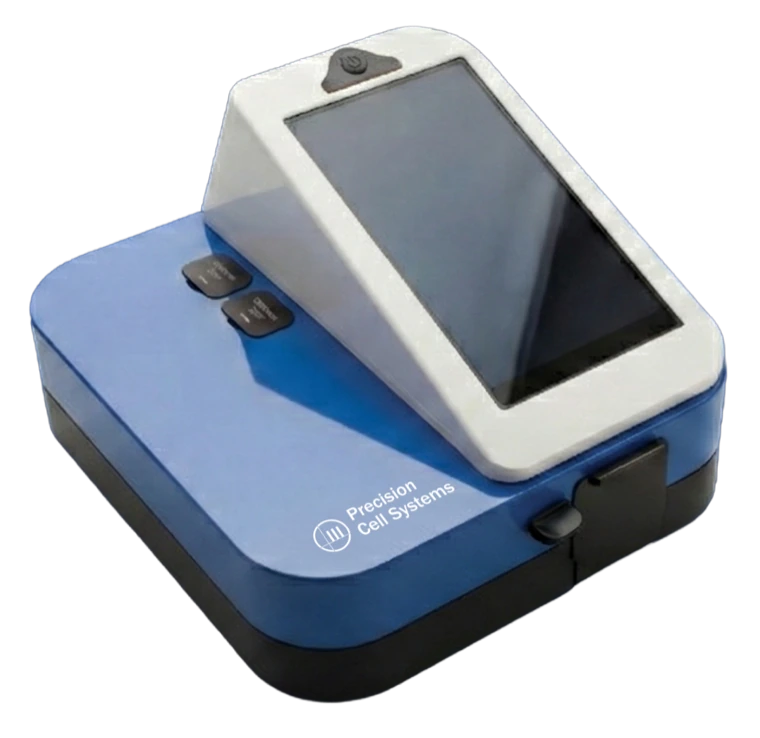
At-line QC for CAR-T manufacturing. The Moxi GO II gives MSAT and QC teams a volumetric cell count, PI viability, and a CD or CAR identity check in 10 to 15 seconds per sample. It runs at the line, under 21 CFR Part 11.
Release QC for an autologous CAR-T lot is a lot of one. The sample is precious and the clock is release-critical. Three questions have to be answered before the product moves: how many cells, are they alive, and are they the right cells.
One benchtop counter
How many cells, on a separate instrument.
Image-based counter or manual stain
Whether they are alive, on yet another readout.
CD3 / CD4 / CAR
In the core flow cytometry lab: booked, off the floor, and shared.
Every handoff consumes sample, adds hands-on time, and opens a gap in the release record. And when the count itself carries 20 to 30 percent variability, the number your release decision rests on is the softest part of the file.
The bottleneck sits where count, viability, and identity split across instruments and leave the floor.
The drug product.
How many, how healthy.
split across instruments todayCD3 / CD4 / CAR.
off-floor in the core lab todayAssemble the record, disposition the lot.
The at-line consolidation. The Moxi GO II collapses step 2 and the routine part of step 3 into one run at the line. A volumetric count, PI viability, and a CD or CAR marker come off one cassette. That keeps the core flow cytometry lab for the high-parameter identity and potency panels only it can run.
A volumetric count, PI viability, and a CD or CAR identity check from a single Type S+ cassette in 10 to 15 seconds, up to 40,000 particles per test. No transfer between a counter, a viability reader, and a core instrument.
21 CFR Part 11 Secure Mode — an activated audit-trail module — logs every action, requires an e-signature, uses role-based access, and lets only an Admin delete. The release record is built as you run, not reconstructed after.
The GO II handles the routine at-line count, viability, and identity check. Your core-facility analyzer stays reserved for the high-parameter identity and potency work only that analyzer can do.
In a peer-reviewed CAR-T manufacturing QC study at Penn Medicine, the Moxi GO II was compared head to head against the methods a manufacturing lab already trusts. Count and size showed no significant difference versus a reference volumetric sizer; viability and identity tracked a reference fluorescence analyzer.
Pajarillo R, et al. Cytotherapy 2024;26(5):506–511. Count precision published by PCS.
| Sample | Works at concentrations as low as 3,000 cells/mL |
|---|---|
| Consumable | Single-use Type S+ cassette, zero-fluidics (a clean path every test) |
| Size range | 3–34 µm, cassette-dependent |
| Detection | Volumetric (physics-based) sizing, plus a 488 nm laser and dual PMT (green 525/45 nm and a swappable red channel) |
| Throughput | up to 40,000 particles per test in 10–15 seconds |
| Data | FCS 3.1 export; 21 CFR Part 11 Secure Mode (activated audit-trail module) |
| Footprint | 7 lb, at the line, next to the biosafety cabinet |
It is not a full identity or potency panel, and it is not meant to be. It covers the routine at-line count, viability, and CD/CAR check that gates most in-process and release steps, and it reserves your core-facility analyzer for the high-parameter work only that analyzer can do. If your release assay must be a full high-parameter identity panel, that belongs on the core instrument, and you will know that quickly.
Secure Mode, the activated 21 CFR Part 11 audit-trail module, logs every change, requires an e-signature, uses three access roles, and lets only an Admin delete. We will walk through it with you and bring the IQ/OQ package for your validation file.
Parity-class. In the Penn study the count showed no significant difference versus a reference volumetric sizer, and precision runs under 2% CV, against 20 to 30% for image-based counters.
For Research Use Only. Not for use in diagnostic procedures.
Cited data is drawn from Pajarillo R, et al. Cytotherapy 2024;26(5):506–511 (DOI 10.1016/j.jcyt.2024.01.007) and PCS application-note data.